
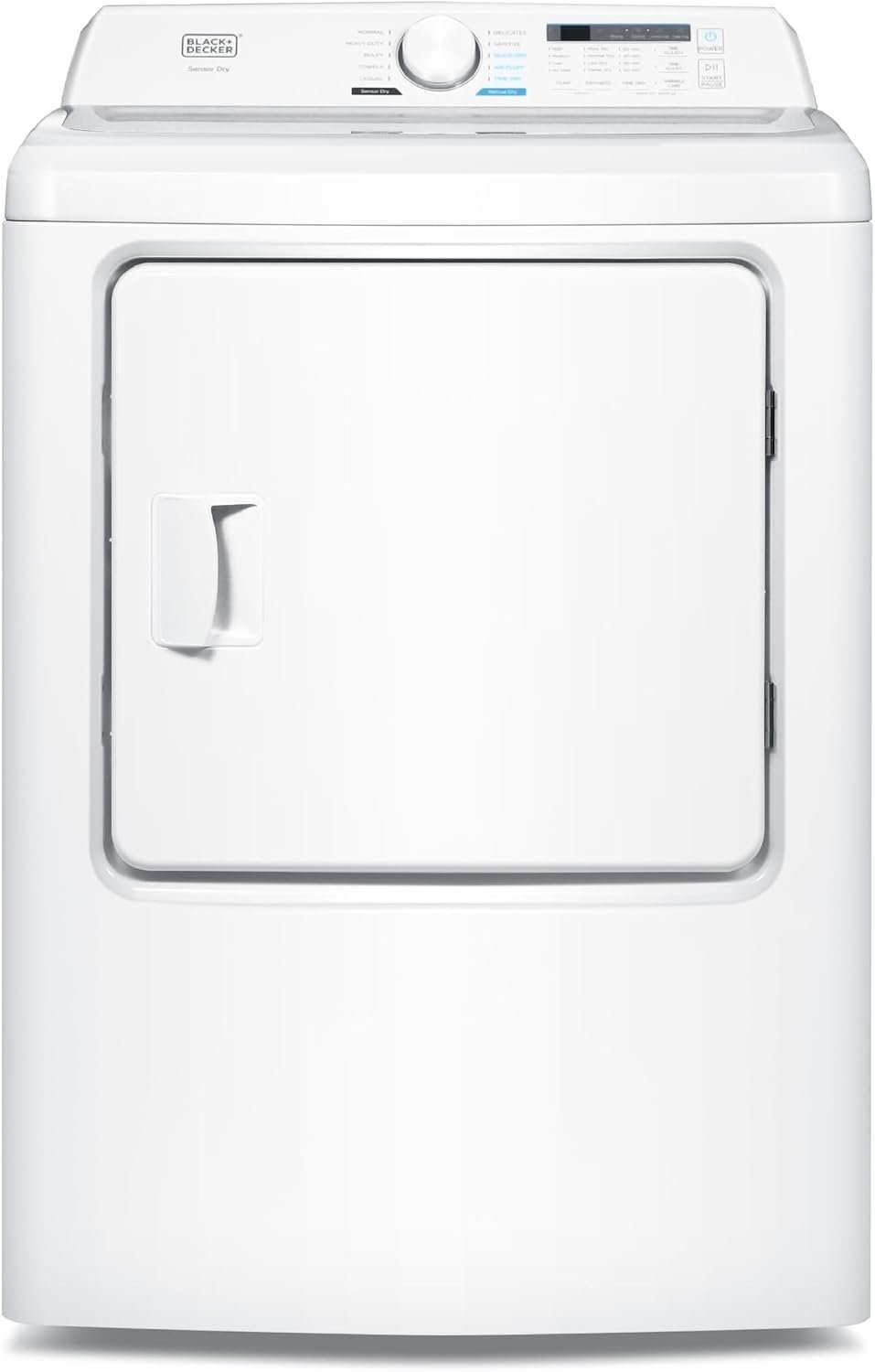
BLACK+DECKER BLD67ME: An Overview of Its Standout Features
BLACK+DECKER equips its 7.0 Cu. Ft. Front Load Dryer, model BLD67ME, with a full digital LED display that shows cycle status, dry time, and sensor selections at a glance, distinguishing it from dial-only competitors in its capacity class. This BLACK+DECKER 7.0 Cu. Ft. front load review examines how that display, paired with five sensor dry settings and five manual dry selections, positions the appliance for households that want precise, tailored drying without a steep learning curve. Laundry rooms come in many shapes, and a front load dryer with a reversible pull-handle door can adapt to tight hallway closets, garage setups, or dedicated utility rooms where door swing direction matters. Fabric care is another consideration households weigh heavily, since bulky towels, large bed sheets, and delicate synthetics all demand different heat levels and drying durations. A stainless steel drum paired with a glass door window allows visual monitoring of a load without interrupting a cycle, while the 240V electric configuration ties performance directly to home wiring capacity. The sections that follow break down capacity, drying performance, control usability, energy and noise characteristics, and installation requirements, giving prospective buyers a structured way to judge whether this specific model matches their laundry room, household size, and fabric care habits before committing to professional installation.
Quick Overview
| Feature | Details |
|---|---|
| Appliance Type | Electric front load clothes dryer |
| Brand / Model | BLACK+DECKER BLD67ME |
| Drum Capacity | 6.7 cubic feet (marketed as 7.0 Cu. Ft. class) |
| Installation Type | Front load; professional installation required; 240V electric power |
| Control System | Digital LED display with dial control |
| Dry Settings | 5 sensor dry selections, 5 manual dry selections |
| Door Design | Reversible pull-handle door |
| Drum & Door Material | Stainless steel drum, glass door window |
| Dimensions | 30.1″D x 27″W x 43″H |
| Weight | 110 pounds |
| Warranty | 1-year limited warranty |
| Intended Household Size | Medium to large households with regular multi-load laundry routines |
| Customer Rating | 4.1 out of 5 from approximately 2,809 ratings |
These specifications translate into a full-size dryer built for households that generate consistent laundry volume rather than occasional single loads. The 6.7 cubic foot drum, digital controls, and dual sensor-and-manual drying modes suggest a unit designed to pair with a matching front load washer in a dedicated laundry space, while the 240V requirement and professional installation note signal that buyers should plan electrical and venting logistics before purchase rather than after delivery.

BLACK+DECKER 7.0 Cu. Ft. Front Load Review: Drying Performance and Sensor Technology
Drying performance on this model hinges on how its five sensor dry selections interact with fabric type and load size, since sensor-based drying relies on internal moisture detection to end a cycle once clothes reach a target dryness rather than running a fixed timer regardless of actual conditions. This approach reduces the risk of over-drying delicate synthetics or under-drying dense items like towels and bedding, both of which are common friction points for households mixing fabric types in a single load. The five manual dry selections supplement this by giving users direct control over heat and duration when a sensor-based guess is not desirable, such as for craft projects, damp-dry finishing before ironing, or partial touch-up cycles. Together, the ten total selections give the BLD67ME more granularity than single-mode dryers, which matters for households juggling everything from delicate activewear to heavy-duty work uniforms within the same appliance.

Five Sensor Dry Settings Explained
Sensor dry settings on this dryer are designed to stop a cycle automatically once fabric reaches a target moisture level, rather than relying solely on a preset timer. This matters for mixed loads containing both lightweight and heavyweight items, since a timer-only approach tends to either leave heavier fabrics damp or over-dry lighter pieces. Because the sensors respond to actual moisture readings, households with varied wardrobes may notice more consistent results across different fabric weights without manually recalculating dry times for every load composition.
Five Manual Dry Selections for Direct Control
Manual dry selections give users the ability to override automatic sensing when a specific outcome is needed, such as a damp-dry finish for garments that will be ironed or a controlled low-heat cycle for delicate blends. This flexibility benefits households that regularly handle specialty items alongside everyday laundry, since it avoids forcing every load through the same sensor logic. The trade-off is that manual settings require the user to estimate appropriate time and heat combinations rather than letting the appliance determine them automatically.
Controls, Display, and Everyday Usability
The digital LED display is the operational centerpiece of this dryer, presenting cycle selection, remaining dry time, and sensor status in a single readable panel rather than relying on unmarked dial positions or blinking indicator lights. Paired with a rotary dial for cycle selection, the control layout follows a familiar pattern that many households already understand from similar appliances, which can shorten the learning curve after installation. The reversible pull-handle door adds a practical usability layer, since laundry rooms are not uniform in layout and a door that can be reconfigured to swing in either direction accommodates tight spaces, side-by-side installations, or stacked configurations where clearance is limited. Ease of use ultimately depends on how clearly these elements communicate status during a cycle, and a digital display paired with dial-based selection generally reduces guesswork compared to dryers using only mechanical timers.

Digital LED Display and Cycle Monitoring
The LED display continuously shows which cycle is active, how much time remains, and which sensor or manual setting has been selected, allowing users to check progress without opening the door or interrupting airflow mid-cycle. This kind of at-a-glance monitoring is particularly useful in shared households where multiple people may start or check on a load throughout the day. Clear digital feedback also reduces the likelihood of accidentally restarting or misconfiguring a cycle, since selections are visible rather than inferred from dial position alone.
Dial Control Operation
The dial control governs cycle and setting selection, offering a tactile, familiar interaction method that many users find quicker than navigating touchscreen menus. Because the dial works in tandem with the digital display, selections are confirmed visually rather than left ambiguous, which reduces setup errors. This hybrid approach of physical dial plus digital readout balances simplicity for less tech-oriented users with the precision that sensor-based drying selections require.
Reversible Pull-Handle Door
A reversible door hinge allows the swing direction to be changed to fit a specific laundry room layout, which is especially relevant for closet installations, narrow hallways, or side-by-side washer-dryer pairs where door clearance can otherwise become a daily inconvenience. This design choice reflects an understanding that front load dryers are often installed in constrained spaces rather than open utility rooms. Reconfiguring the hinge typically requires basic tools and is generally handled during initial setup rather than as a routine adjustment.
Energy Use, Noise, and Vibration Control
As a 240V electric dryer, this model’s running costs and performance are tied directly to home electrical capacity rather than gas line availability, which simplifies installation logistics for homes already wired for high-voltage appliances but adds a prerequisite step for those that are not. Electric dryers of this capacity generally cycle through heating elements that consume more continuous power than gas counterparts, though efficiency also depends heavily on sensor-based cycle termination, which limits unnecessary run time once fabric reaches target dryness. Front load dryers with enclosed stainless steel drums also tend to manage vibration differently than top load or older mechanical designs, since drum balance and door sealing influence how much noise and shake transfers to the surrounding floor or cabinetry during operation. Households in apartments, multi-level homes, or laundry closets adjacent to living spaces should weigh these acoustic and vibration characteristics alongside raw drying capacity.

Electric 240V Operation and Running Costs
Operating on a 240V circuit means this dryer requires a dedicated high-voltage outlet or direct wiring connection rather than a standard household outlet, which is a meaningful planning consideration for buyers moving from a shared laundromat setup or an older home without existing 240V infrastructure. Once installed, electric dryers in this capacity range typically draw significant power during heating cycles, and actual running cost depends on regional electricity rates and how often sensor dry settings shorten cycle length. Because sensor-based drying reduces unnecessary runtime, energy use over time may be more predictable than with timer-only electric dryers.
Noise and Vibration Characteristics
Vibration and noise levels in front load dryers are influenced by drum balance, load distribution, and how securely the unit is leveled during installation. An unevenly loaded drum, particularly with bulky items like comforters, can produce noticeable thumping regardless of build quality, which is a characteristic of drum-based drying rather than a defect specific to this model. Households prioritizing quiet operation, especially in apartments or homes with laundry areas near bedrooms, should ensure proper leveling and avoid consistently overloading the drum beyond its rated capacity.
Installation Requirements, Space Planning, and Long-Term Durability
Professional installation is a mandatory consideration for this dryer, since it requires a UL-listed 3-wire or 4-wire power cord kit or direct wiring performed according to local electrical codes, none of which is included in the box. This distinguishes it from plug-and-play appliances and means buyers should budget time and access to a qualified installer before delivery rather than treating setup as a same-day task. At 30.1 inches deep, 27 inches wide, 43 inches tall, and 110 pounds, the unit demands accurate space measurement and a stable, level floor surface, particularly if it will be stacked with or placed beside a matching washer. Long-term durability is supported by a stainless steel drum, which resists rust and denting better than painted steel over repeated cycles, though the glass door and control panel electronics represent components that typically require more careful handling than the drum itself. Routine lint filter maintenance and periodic vent inspection remain necessary regardless of drum material, since airflow restriction is a leading cause of reduced drying efficiency and elevated internal temperatures over time.

Professional Installation and Electrical Requirements
Because the manufacturer specifies that installation must be performed according to local codes using a UL-listed power cord kit or direct wiring, this is not a dryer suited to casual self-installation for buyers unfamiliar with electrical work. Homes lacking existing 240V dryer circuits will need additional electrical work before the unit can be connected, which should factor into any installation timeline. Planning for professional setup in advance helps avoid delivery delays or a dryer sitting unused while wiring is arranged.
Dimensions and Laundry Room Space Planning
At just over 30 inches deep and 43 inches tall, this dryer requires adequate clearance for door swing, venting, and rear access for the power connection, particularly in closet or alcove installations. The 110-pound weight also means the installation surface should be level and structurally sound, especially in upper-floor laundry rooms. Buyers pairing this unit with a matching washer in a side-by-side or stacked configuration should confirm combined width and height clearances before finalizing a layout.
Build Quality, Filter Maintenance, and Long-Term Care
The stainless steel drum construction is a durability-oriented design choice, since it resists the corrosion and denting that can affect painted steel drums after years of use with metal zippers, buttons, or damp fabric. Regular lint filter cleaning after each cycle, along with periodic exterior vent inspection, remains essential to maintaining airflow and preventing the drying inefficiency that accumulates when lint restricts exhaust paths. The one-year limited warranty covers early-life defects but places long-term maintenance responsibility on the household, making routine filter and vent care a meaningful factor in how long the appliance performs at its rated capacity.

Pros & Cons
Pros
- Dual sensor and manual drying modes give households flexibility between automated moisture-based drying and direct manual control for specialty loads, covering a wider range of fabric care needs than single-mode dryers.
- Digital LED display presents cycle, time, and sensor information clearly, reducing guesswork compared to dryers that rely on unmarked dials or blinking lights alone.
- Stainless steel drum construction offers better long-term resistance to rust and denting than painted steel drums, supporting durability across repeated heavy-use cycles.
- Reversible pull-handle door adapts to varied laundry room layouts, which is particularly useful in closet installations or side-by-side appliance configurations with limited clearance.
- 6.7 cubic foot capacity accommodates bulky items like large comforters and bath towels in fewer loads, benefiting medium to large households with frequent laundry needs.
- Strong customer sentiment, reflected in a 4.1 out of 5 rating across roughly 2,809 reviews, suggests broad satisfaction among buyers who have integrated the unit into daily use.
- Glass door window allows visual load monitoring without opening the door mid-cycle, helping preserve heat retention and cycle efficiency.
- 240V electric configuration simplifies integration into homes already equipped with dryer-rated circuits, avoiding the need for gas line installation.
Cons
- Mandatory professional installation adds a planning step and potential cost consideration, since the required power cord kit is not included and direct wiring must follow local codes.
- 240V requirement means homes without existing high-voltage dryer circuits will need additional electrical work before the unit can be used.
- 110-pound weight and front-load dimensions require careful space planning and a level, structurally sound installation surface, particularly in upper-floor laundry rooms.
- Manual dry selections require user judgment, since achieving a specific dryness level without sensor assistance depends on the user correctly estimating time and heat settings.
- One-year limited warranty is comparatively standard rather than extended, placing more long-term maintenance responsibility on the household after the initial coverage period ends.
Final Verdict: Who This Washer or Dryer Is Best For (and Who Should Skip It)
The BLACK+DECKER BLD67ME suits medium to large households that generate consistent laundry volume and want a full-size, front load dryer with both automated sensor drying and manual override options. Its 6.7 cubic foot stainless steel drum, digital LED display, and reversible door make it a practical fit for dedicated laundry rooms, closets with directional door constraints, or side-by-side pairings with a matching front load washer. Households that value visible cycle feedback over blind timer-based operation, and that are prepared to arrange professional installation on a 240V circuit, are likely to find the control layout and drying flexibility well matched to everyday fabric care needs, from bulky bedding to mixed synthetic loads.
Buyers without access to an existing 240V dryer circuit, or those seeking a plug-and-play appliance requiring no professional setup, may find the installation prerequisites more demanding than simpler electric or gas alternatives. Similarly, households prioritizing an extended warranty period beyond the standard one-year limited coverage might weigh that limitation against comparable front load dryers available in 2026. For most laundry-heavy households willing to plan electrical logistics in advance, however, the combination of sensor precision, manual flexibility, and digital monitoring represents a reasonably well-rounded appliance within its capacity class.
Frequently Asked Questions (FAQs)
How many pounds of laundry can a 6.7 cubic foot dryer hold?
A 6.7 cubic foot drum can generally accommodate loads in the range of large bath towel sets, queen or king bedding, and mixed family laundry without excessive crowding. Actual capacity in practice depends on fabric bulk rather than weight alone, since bulky items like comforters take up more drum space than dense items like jeans. Households with frequent large loads benefit most from this capacity class.
Does this dryer require a special electrical outlet?
Yes, this model operates on a 240V electrical connection and requires professional installation using a UL-listed 3-wire or 4-wire power cord kit, which is not included, or a direct wiring connection performed according to local codes. Homes without an existing 240V dryer circuit will need additional electrical work completed before the appliance can be connected and used, so confirming outlet compatibility ahead of delivery is advisable.
What is the difference between sensor dry and manual dry settings?
Sensor dry settings use internal moisture detection to end a cycle automatically once fabric reaches a target dryness level, adjusting run time based on actual load conditions. Manual dry settings instead rely on a fixed time and heat combination chosen by the user, which is useful for specialty items or partial drying but requires more guesswork than sensor-based cycles to avoid over- or under-drying.
Can the dryer door be installed to open in either direction?
Yes, the front load door on this model is reversible, meaning its swing direction can be reconfigured to suit different laundry room layouts. This is particularly useful in closet installations, narrow hallways, or side-by-side appliance setups where a fixed door swing could otherwise limit clearance or accessibility during everyday use. Reconfiguring the hinge is typically handled during initial setup with basic tools rather than as a routine adjustment.
Is a front load electric dryer noisy during operation?
Noise and vibration in front load dryers largely depend on drum balance, load distribution, and how well the unit is leveled during installation rather than being fixed characteristics of the appliance alone. Uneven loads, particularly bulky single items like comforters, can increase thumping regardless of build quality, so proper leveling on a stable floor and balanced loading help minimize noise in most everyday installations.
How long is the warranty on this BLACK+DECKER dryer?
The appliance carries a one-year limited warranty covering defects from the manufacturer, W Appliance LLC. This is a standard coverage period for appliances in this capacity class, though it places greater responsibility on the household for long-term maintenance tasks like filter cleaning and vent inspection once the initial coverage period has ended and routine upkeep becomes the owner’s ongoing responsibility.
What maintenance does a stainless steel drum dryer need over time?
Routine maintenance includes cleaning the lint filter after every cycle and periodically inspecting the exhaust vent for lint buildup, since restricted airflow reduces drying efficiency and can raise internal operating temperatures. While a stainless steel drum resists rust and denting better than painted steel over time, it does not eliminate the need for regular filter and vent upkeep to keep the appliance running efficiently.
Is this dryer suitable for an apartment or small laundry closet?
It can fit closet-style installations given its reversible door design, but its 30.1-inch depth, 43-inch height, and 110-pound weight require accurate space measurement before installation. Apartment dwellers should also confirm access to a 240V circuit, since many apartment laundry closets are wired differently than dedicated house laundry rooms, and professional installation is required regardless of location, building type, or unit size.