

Kenmore 4.5 cu. ft. Top Load vs Front Load: One Drum Size, Two Machines
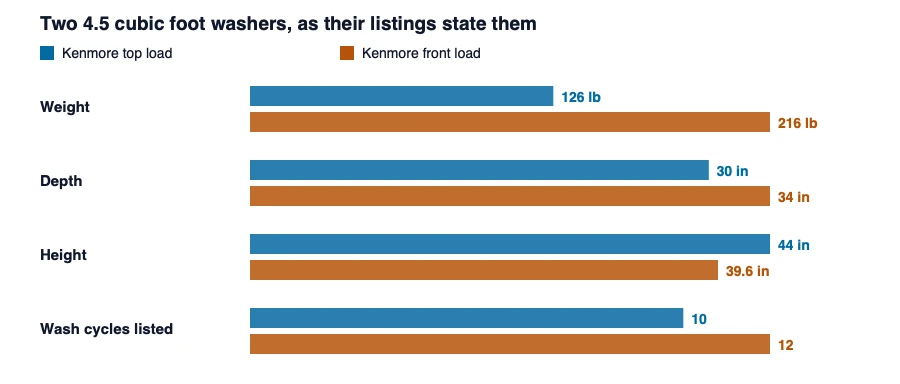
Two Kenmore washers with the same stated 4.5 cubic foot drum. One weighs 126 pounds and the other 216, and that gap is the largest difference on either listing.
The two listings at a glance

Triple Action Impeller, knob and touch controls
Read our review · Check price on Amazon
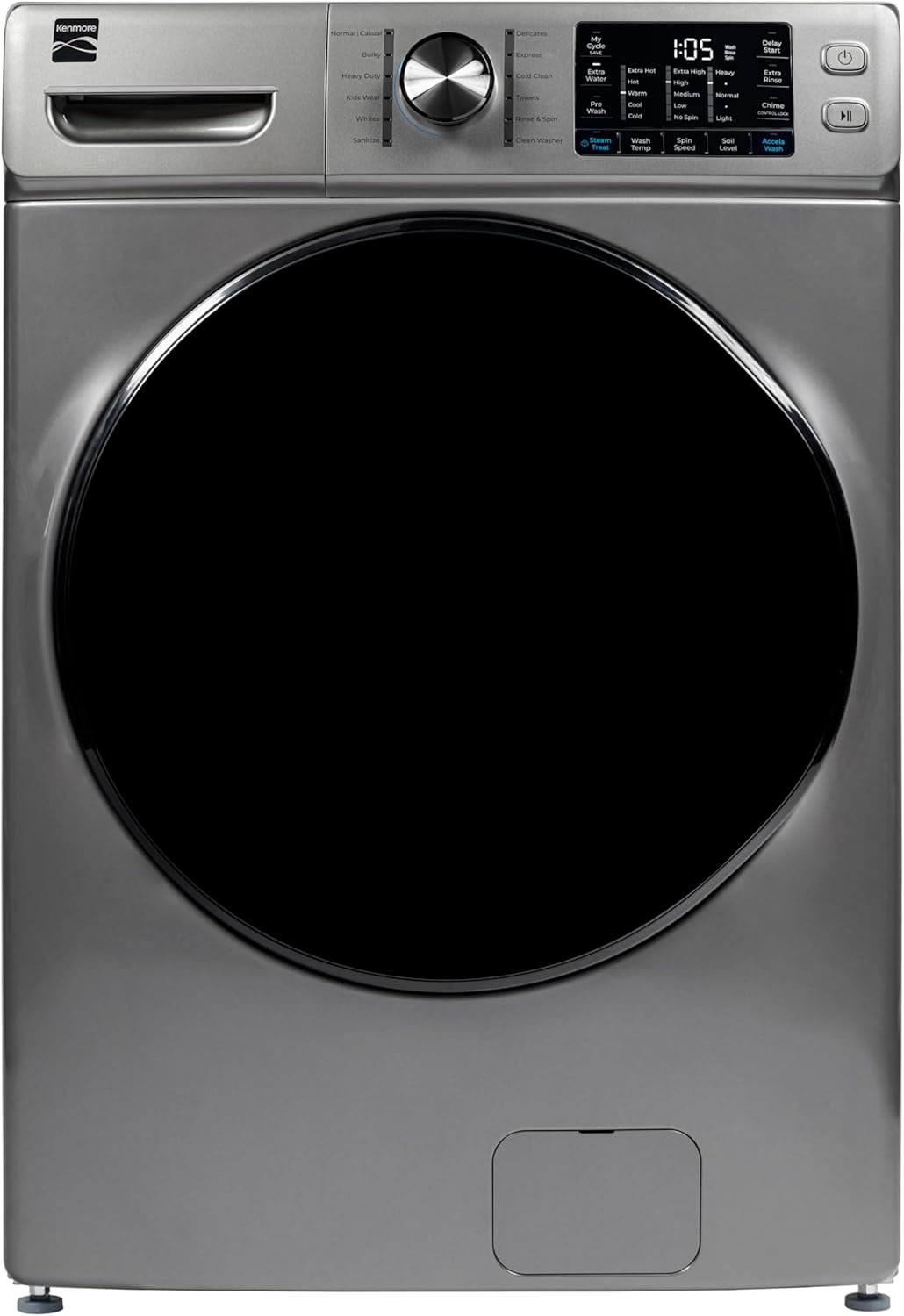
Steam treatment, touchscreen
Read our review · Check price on Amazon
These are two washers from one brand, with one stated drum size, filed under one category, and the single difference that most shoppers start with: whether the door is on the top or the front. Both listings say 4.5 cubic feet, both are freestanding and fully automatic, our reviews describe both as ENERGY STAR certified, and our reviews and Amazon’s pages agree on the capacity. That makes this a rare comparison in which the headline figure is held still, so what moves is everything the headline figure does not capture.
| Figure | Kenmore top load | Kenmore front load | Full-size washer median |
|---|---|---|---|
| Drum volume | 4.5 cu ft (both sources) | 4.5 cu ft (both sources) | 4.3 cu ft |
| Weight | 57 kg, 125.7 lb (listing only) | 98 kg, 216.1 lb (listing only) | 57 kg, 126 lb |
| Footprint, W x D x H | 27″ W x 30″ D x 44″ H | 27″ W x 34″ D x 39.6″ H | — |
| Floor area | 810 sq in | 918 sq in | — |
| Wash cycles on the listing | 10 standard, 7 programs | 12 standard, 8 programs | — |
| Stated noise | not stated | 60 dB (listing only) | 6 of 13 state one |
| Controls | Knob and touch | LED touch controls | — |
| Speed claims | Express Wash, 30 minutes | Express Wash, 25 minutes | — |
| Price band | $500+ | $500+ | — |
The same drum, 90 pounds apart
The top load is listed at 125.7 pounds, or 57 kilograms. The front load is listed at 216.1 pounds, 98 kilograms. That is 41 kilograms, or 72 percent, more machine to hold the same 4.5 cubic feet, and it is the biggest difference between the two listings. Put as weight per cubic foot of drum, the top load carries 12.7 kilograms and the front load 21.8. The class of full-size washers in our catalogue has a median listed weight of 57 kilograms, and among the larger machines the door explains most of the spread: 4 top loads of 4.1 cubic feet or more are listed between 50 and 57 kilograms, and 3 front loads of 4.4 or more between 98 and 102. The 3 compact front loads, at 2.2 to 2.8 cubic feet, are the exception, listed between 33 and 73 kilograms.
Why would the same volume of drum weigh so differently? The listings do not say, and we are not going to supply a reason as if it came from them. What can be said from the pages is that the front load lists a stainless steel drum and plastic in its material field, while the top load lists steel, and that a front-loading machine usually carries a heavier cabinet and counterweights to hold a drum that spins on a horizontal axis. That is general knowledge about the type, not a reading of either listing, and it is the reason the weight matters in practice: the heavier machine is harder to get up a stairway, and the lighter one is the one you can move yourself.
What each one asks of the room
Both listings give a width of 27 inches. The depth is where they part: 30 inches for the top load and 34 for the front load, which makes the floor footprint 810 square inches against 918, 13 percent more floor for the front load. Height runs the other way, 44 inches against 39.6. A top load that opens upward needs headroom above it for the lid, a front load needs clearance in front for the door, and neither listing states the clearance it needs, so the figures above are the cabinet only. If the machine goes under a shelf, in a closet or in a stack with a dryer, you will want those numbers from the manufacturer and not from this page.

Cycles and speed: two claims that cannot be set side by side
The top load lists ten standard cycles and seven programs on Amazon’s page, and its bullets name heavy duty, whites, towels, delicates and an Express Wash. The front load lists twelve standard cycles and eight programs, with Kids Wear, Sani Rinse and a steam treatment among them. That is two more cycles on the front load, and it is the one place where the front load simply lists more.
Both listings also make a speed claim, and they look comparable and are not. The top load says Express Wash cleans a small load in 30 minutes, measured on a 3-pound load at the default setting, and that its Accela Wash cleans a full-size load up to 51 percent faster than a standard 8-pound load. The front load says Express Wash takes 25 minutes on a 3-pound load on the express cycle, and Accela Wash is up to 26 percent faster. The first pair is a stated time on a stated load, five minutes apart and on different cycle settings. The second pair are percentages, and a percentage is only as meaningful as the baseline it is measured against: each listing says it is faster than a “standard” 8-pound load, but a standard cycle on a top load and on a front load are not the same wash. So 51 and 26 cannot be read as one machine being twice as quick, and we do not.
What is stated for one and not the other
Noise appears on one listing only: 60 dB for the front load, and nothing for the top load. Neither lists a maximum spin speed, which is the figure that decides how much water a load carries out of the machine and into the dryer. The front load’s Amazon page lists a touchscreen as its human interface and a stainless steel drum; the top load’s lists a stainless steel drum and an LED display, with a soft-close glass lid mentioned in its bullets. Neither page gives a water-use figure. Our review tables agree with Amazon on the capacity and the installation type for both machines, and quote a one-year limited warranty for both.
It is also worth being clear about what ENERGY STAR means on these pages. Our reviews describe both machines as certified, Amazon’s text for the front load says so too, and the top load’s review row adds that the certification is based on 2026 standards, a phrase the top load’s own Amazon page does not carry. We have not looked up the certification database for either model, so we record the statement as the listing’s. The statement does not tell you which machine uses less water or electricity, and neither listing gives the number needed to find out.
Which suits which
The top load suits you if
- weight is the constraint. At 125.7 pounds it is the lighter listing by 90 pounds, which matters on stairs and in a rented space;
- floor area is tight. It takes 810 square inches against 918, though it is 4.4 inches taller;
- you prefer knobs to a touchscreen, which is how its listing describes the controls;
- you can confirm the lid clearance with the manufacturer before ordering.
The front load suits you if
- you want the longer list of cycles, twelve against ten, including a steam treatment and a Kids Wear cycle;
- you want a stated noise figure to start from, with the caveat that 60 dB is a claim and the other machine states none;
- you have the floor depth and the door clearance, and a way to move 216 pounds into place;
- you want the lower cabinet height, 39.6 inches against 44, and have the floor depth to give.
What this comparison cannot tell you
Nothing here was tested. We did not run a load through either washer, so we cannot say which gets clothes cleaner, which leaves them wetter, which is louder at the spin or which one is more reliable after a year. The two price bands are the same, so cost does not separate them. If you want the case for one or the other, read our Kenmore top load review and our Kenmore front load review. For where either machine sits among the full-size washers we have reviewed, the washing machine reviews list them.
Figures are the manufacturers’, as published on each listing and quoted in our reviews; none was measured by us. How we work · Affiliate disclosure